If you’re looking for a reliable bug killer for houseplants, you want products that control pests quickly without harming your plants or family. The best options below are selected for indoor use, broad pest coverage, and practical application. This guide helps indoor gardeners choose the right product for their needs, whether you favor systemic protection, contact sprays, or organic alternatives. The table summarizes top picks for quick reference.
| Product | Brand | Best For | Use Type |
|---|---|---|---|
| Bonide Systemic Houseplant Insect Control | Bonide | Containerized houseplants needing long-lasting protection | Granules, systemic |
| Garden Safe Brand Houseplant & Garden Insect Killer2 | Garden Safe | Homes, gardens, and greenhouses seeking quick-contact action | Ready-to-use spray |
| BioAdvanced Houseplant Insect and Mite Control Spray | Bayer Advanced | Indoor/outdoor mixed plant care with pests and mites | Ready-to-use spray |
| BioAdvanced Organics Brand Houseplant Insect Killer | Bayer Advanced | Organic options that also tackle powdery mildew | Ready-to-use spray |
| Kate’s Home & Garden Plant Spray for Insects | Kate’s Home & Garden | Natural, peppermint-based control with gnats and fungus gnats | Ready-to-use spray |
Bonide Systemic Houseplant Insect Control

Best for: containerized houseplants that need ongoing protection. This ready-to-use granule form is absorbed by roots and travels through the plant to combat listed insects. It lasts up to eight weeks per application, helping reduce the frequency of sprays. It works by ingestion, targeting pests such as mealybugs, aphids, and scale.
Why selected: The systemic approach provides long-lasting protection, which is advantageous for busy households or plants that are hard to reach with sprays. A caution: it is not effective against insects that do not feed on the plant, so complementing with a contact spray may be necessary for some pests.
Garden Safe Houseplant & Garden Insect Killer2

Best for: homes, gardens, and greenhouses needing broad, fast-acting control on contact. This product kills over 100 listed insects on contact and can be used up to the day of harvest for edible crops. It covers vegetables, herbs, ornamental plants, and houseplants alike.
Why selected: Its wide spectrum and harvest-friendly timing make it a versatile option for mixed plant settings. Limitation: it relies on contact kill, so hidden or deeply protected pests may require multiple applications or complementary methods.
BioAdvanced Houseplant Insect and Mite Control Spray

Best for: indoor and outdoor care with integrated pest and disease management. This spray provides insect kill for common pests like aphids, fungus gnats, and whiteflies, and also targets diseases such as powdery mildew, leaf spot, and rust when used as directed.
Why selected: An all-in-one option that blends insect, mite, and disease control in one bottle, reducing the number of separate products you need. Caution: effectiveness requires direct contact with pests, so thorough coverage is important.
BioAdvanced Organics Brand Houseplant Insect Killer
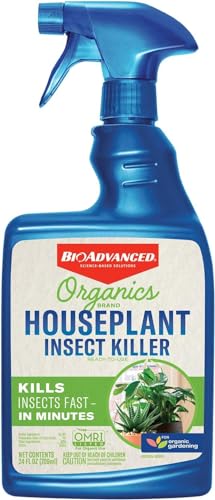
Best for: gardeners seeking an OMRI-listed organic option that also helps manage powdery mildew. This quick-acting spray targets a range of pests, including aphids, mealybugs, scale insects, and whiteflies, on both indoor and outdoor plants.
Why selected: The OMRI listing provides compatibility with organic gardening goals, making it a suitable choice for edible plants and ornamental varieties. Limitation: organic formulations can be slower to act than synthetic options in some scenarios, so early treatment is beneficial.
Kate’s Home & Garden Plant Spray for Insects

Best for: indoor plant owners seeking a peppermint-based, natural solution that helps with gnats, fungus gnats, and related pests. The bundle includes 12 sticky traps for enhanced control.
Why selected: The peppermint oil formula offers a safer, fragrance-friendly approach that appeals to households prioritizing natural ingredients. Caution: customers should verify trap availability if ordering alongside the spray, as shortages can occur, and some users may prefer additional non-chemical strategies for persistent gnats.
Buying Guide
What type of product should I choose for indoor plants?
– Ready-to-use sprays are convenient for quick coverage and immediate results. They’re ideal for routine maintenance and spot treatments on houseplants with visible pests.
– Systemic granules provide longer-lasting protection for container plants, reducing the need for frequent applications but require root uptake and time to move through the plant.
Should I prioritize organic options?
– Organic, OMRI-listed products are preferred for edible plants or households avoiding synthetic chemicals. They can be gentler on beneficial insects but may require more frequent applications for severe infestations.
Which products balance pest control and plant safety?
– Look for formulations labeled for houseplants, with clear instructions on application, rate, and plant tolerance. Spray products that target multiple pests at once can simplify care, while systemic products excel for consistent protection.
How do I handle sanitation and prevention?
- Inspect new plants before introduction to your home to prevent pest spread.
- Isolate infested plants to limit cross-contamination.
- Wipe leaves, check undersides, and clean pots to reduce hiding spots.
FAQ
- Q: Are these products safe for pets? A: Follow label directions. Some products are formulated to be safe around pets when used as directed, but avoid application on areas accessed by animals unless specified.
- Q: Can I use multiple products together? A: It’s best to avoid mixing unless the label explicitly allows it. Use one product at a time and monitor plant response.
- Q: Do these sprays kill mites? A: Several listed products target mites and related pests, but always verify the pests listed on the label.
- Q: How long does protection last? A: Systemic granules may last up to eight weeks; sprays provide coverage according to label timing, often requiring reapplication every few weeks for ongoing infestation.
- Q: Can I treat edible plants indoors? A: Some products allow use on edible crops up to harvest; check the label to confirm it’s safe for the specific herbs or vegetables you grow.
- Q: Do these kill beneficial insects? A: Most broad-spectrum products affect multiple insects; use targeted applications and avoid flowering plants when beneficial insects are present.