Answering the search for durable, easy-to-install root blockers, these options help prevent root intrusion while keeping trees healthy. The best picks suit homeowners planning long-term landscape protection, property owners with sidewalks or foundations at risk, and DIYers wanting straightforward installation. The top five products below balance depth, material strength, and installability for American yards and driveways.
| Product | Size/Depth | Material Strength | Best For |
|---|---|---|---|
| Renewed Warriors Tree Root Barrier Roll 18in x 15ft | 18 in. x 15 ft | 62.5 mil HDPE | Smaller trees and compact landscapes |
| Renewed Warriors Tree Root Barrier Roll 24in x 15ft | 24 in. x 15 ft | 62.5 mil HDPE | Medium-scale yards with wider planting areas |
| West Bay Tree Root Barrier 20 ft x 24 in x 60 mil | 20 ft. x 24 in. x 60 mil | 60 mil HDPE | Longer runs and stronger penetration resistance |
| Convivium Tree Root Barrier 12in x 20ft x 60mil | 12 in. x 20 ft | 60 mil recycled HDPE | Budget-friendly, recycled material option |
| DeepRoot Tree Root Barrier 12in x 24in, 40 Panels | 12 in. depth, 24 in. width; 40 panels | 60 mil polypropylene (recycled content) | DIY-friendly, modular installation |
Renewed Warriors 18in x 15ft HDPE Root Barrier

The 18×15 ft roll uses a 62.5 mil HDPE barrier to block invasive roots, preventing damage to foundations, concrete, and landscaped areas. Best for smaller trees, edging around beds, or tight yard layouts where a compact barrier is preferred. This option emphasizes durability and puncture resistance for long-term property protection. Caution: shorter length may require multiple rolls for larger projects, which can increase install time.
Renewed Warriors 24in x 15ft HDPE Root Barrier
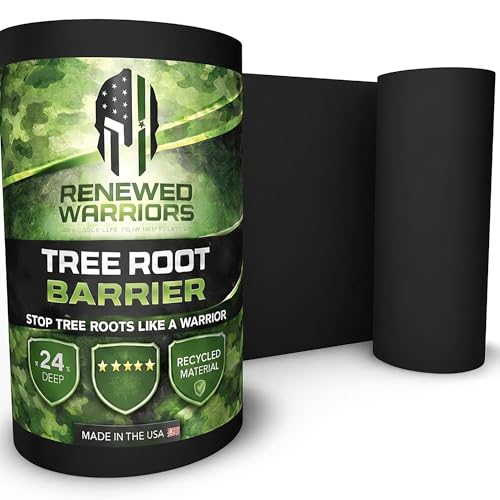
This 24-inch wide barrier provides broader coverage for medium-sized root systems while maintaining the same 62.5 mil thickness. It’s well-suited for urban yards with sidewalks or driveways at risk from surface-root spread. Best for homeowners with more expansive planting beds or where a wider barrier simplifies installation. Limitation: wider sheets may be less maneuverable in narrow spaces.
West Bay 20ft x 24in x 60mil Root Barrier

This 20-foot barrier is 24 inches wide and 60 mil thick, offering stronger deep-root blocking than thinner options. It’s designed to redirect roots downward, preventing surface damage to sidewalks, driveways, and patios. Best for larger yards or longer planting beds where extended coverage reduces seams. Caution: longer lengths can require careful alignment to prevent gaps at joints.
Convivium Tree Root Barrier 12in x 20ft x 60mil

Convivium offers a 60 mil recycled HDPE barrier with a flexible, easy-to-install profile. It’s ideal for DIYers seeking a budget-friendly, durable option that mitigates root intrusion around sidewalks, driveways, and foundations. Best for smaller projects and portable installations. Limitation: recycled HDPE may have variability in color and texture across batches.
DeepRoot 12in x 24in Tree Root Barrier (40 Panels)

DeepRoot’s kit provides 40 panels totaling 40 linear feet of barrier at 12 inches depth and 24 inches width, using durable polypropylene with UV inhibitors. Best for modular installations where you want to tailor the barrier length to irregular spaces around trees. Advantage: strong, long-lasting protection. Caution: traditional panels require trenching and backfilling, which may be labor-intensive for larger landscapes.
Buying Guide
What thickness do I need? Heavier mil (60–62.5 mil) barriers offer greater puncture resistance and longer underground durability, suited for high root pressure areas or properties with tough soils. For lighter-use projects or smaller trees, 40–60 mil options may suffice.
Which width is best for my project? Wider barriers (≥24 in) cover more root area and can reduce seams, but they are harder to maneuver in tight spaces. Narrow widths work well for edging around tree rings or confined beds.
Should I choose HDPE or polypropylene? HDPE is commonly used for commercial-grade root barriers with strong puncture resistance. Polypropylene barriers are durable and often less expensive, with good chemical resistance and flexibility for curved installations.
Is recycled content important? Recycled HDPE options (like Convivium) offer environmental benefits and typically lower cost, but check for uniform thickness and quality across batches to ensure consistent performance.
How long will installation take? Shorter barriers are quicker to install, especially for DIYers. Larger yards with many roots or irregular shapes may require more planning, trenching, and backfilling.
FAQ
- What is the primary purpose of a tree root barrier?
It redirects roots downward, reducing surface damage to sidewalks, driveways, and foundations. - Can I install root barriers above ground?
Yes, many barriers are designed for above-ground or partially exposed installations, but durability may vary with sun exposure. - Do root barriers need maintenance?
They typically require periodic inspection for signs of shift, exposure, or gaps, especially after heavy root growth or weather events. - How many feet of barrier do I need?
Measure the tree canopy spread and the length of hardscape risk; plan for extra length to cover joints and bends. - Are there safety considerations during installation?
Use gloves and proper digging tools, as trenching and handling long rolls can cause strains or injuries. - Can I cut or overlap barrier sections?
Yes, many barriers are designed to be cut cleanly with a utility knife and overlapped for extended coverage.